Research
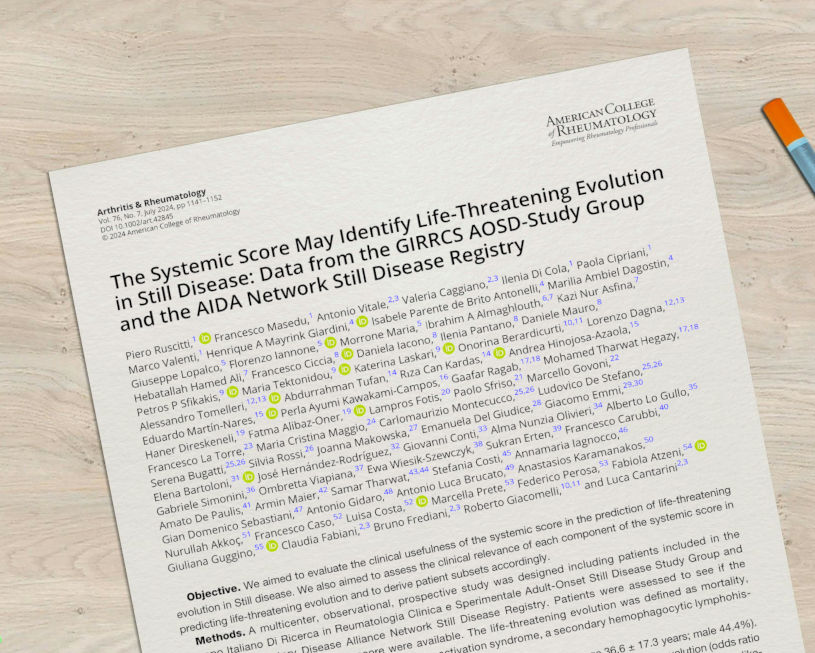
The Systemic Score May Identify Life-Threatening Evolution in Still Disease
Using data from the GIRRCS AOSD-Study Group and the AIDA Network Still Disease Registry, a new study explores the clinical usefulness of the systemic score in predicting life-threatening evolution in Still disease and to derive patient subsets accordingly.
Link to article
DOI: 10.1002/art.42845
In this multicenter, observational, and prospective study involving 597 patients with Still’s disease, researchers leveraged data from the Gruppo Italiano Di Ricerca in Reumatologia Clinica e Sperimentale (GIRRCS) Adult-Onset Still Disease Study Group and the AIDA Network Still Disease Registry. This extensive research has confirmed the pivotal role of the Pouchot systemic score in assessing risk levels for life-threatening progression of Still’s disease. In particular, the study validated the significance of a systemic score ≥7 as a strong predictor of severe outcomes, thus reinforcing previous assumptions about this critical cut-off point. Moreover, the study underscores the importance of closely monitoring patients with liver and lung involvement, highlighting that these organ manifestations are crucial indicators of potential life-threatening complications in this multiorgan disease. Therefore, this large-scale analysis not only supports the use of the Pouchot score but also emphasizes the need for heightened surveillance in patients exhibiting hepatic and pulmonary symptoms.