Research
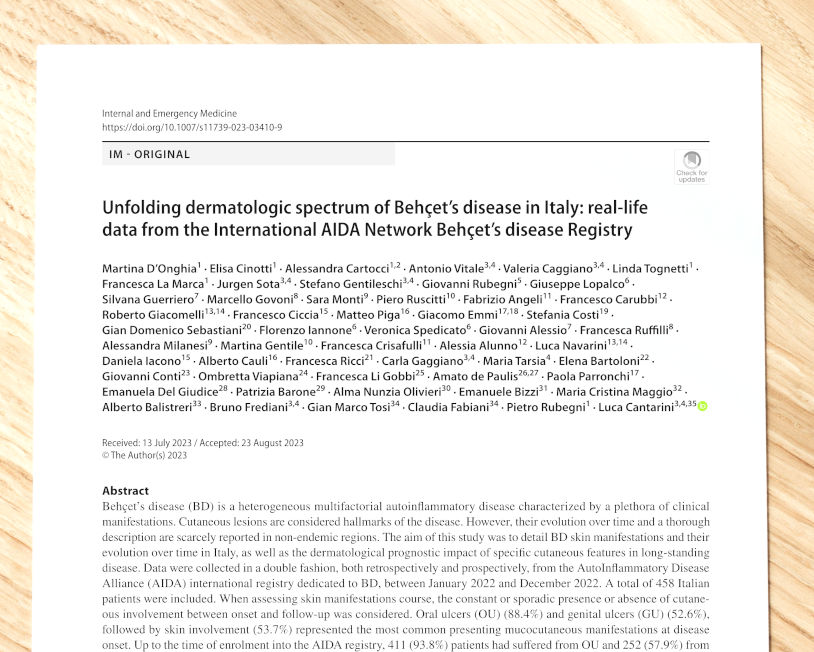
The dermatologic spectrum of Behçet's disease in Italy: disclosed the results of a novel study from the AIDA Network Behçet's disease registry
A novel study based on the AIDA Network Behçet's disease registry has recently been published in Internal and Emergency Medicine.
Link to article
This study explores the baseline characteristics and evolution of skin manifestations in 458 Italian patients with Behçet's disease.
The findings of this research highlight a diverse range of skin manifestations, which align with what is typically seen in endemic regions. At the onset of the disease, oral ulcers were prevalent in 88.4% of patients, followed by genital ulcers in 52.6%, and skin involvement in 53.7%. Among skin manifestations, pseudofolliculitis was the most common, affecting 37.1% of patients, followed by erythema nodosum in 22.3%, skin ulcers in 2%, and pyoderma gangrenosum in 0.9%.
When looking at the whole disease course, of those with skin involvement at disease onset, 16.2% maintained skin lesions throughout the observation period, while 44.1% experienced sporadic skin involvement; conversely, 83.2% of patients without skin involvement at disease onset remained lesion-free. Notably, there was a statistically significant association between pseudofolliculitis and persistent skin involvement during follow-up visits. In summary, this study sheds light on the diversity of clinical presentations and skin manifestations in Italian patients with Behçet's disease and underscores the potential significance of certain skin lesions, particularly ppseudofolliculitis, as indicators of long-term skin involvement, warranting close dermatological attention.