Research
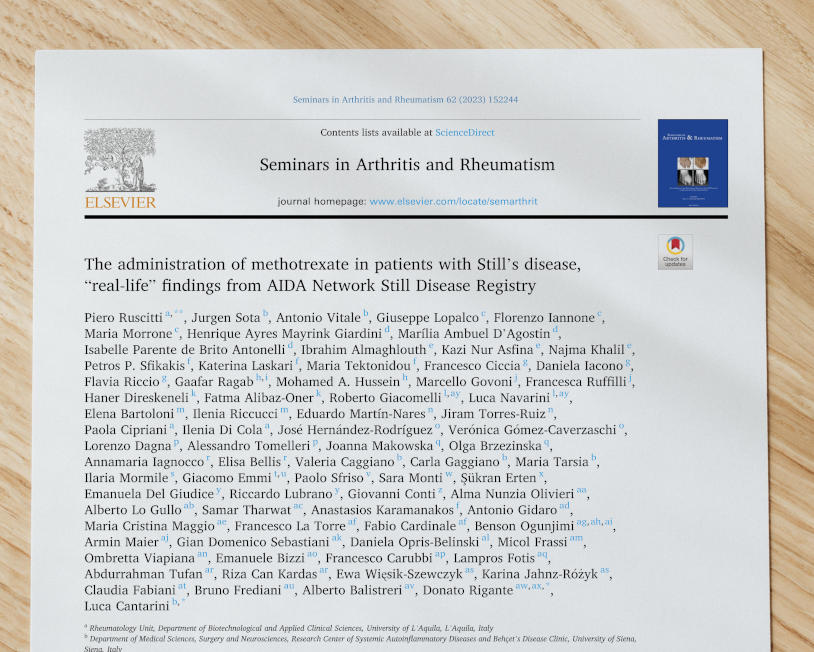
The administration of methotrexate in patients with Still's disease, "real-life" findings from AIDA Network Still Disease Registry
A new paper on methotrexate effectiveness in Still's disease is available in Seminars in Arthritis and Rheumatism
Link to article
This study aimed to describe the clinical characteristics of Still's disease patients treated with methotrexate and evaluate drug effectiveness by assessing changes in disease activity, reduction of inflammatory markers, and glucocorticoid-sparing effect. A cohort of 171 patients from the AIDA Network Still's Disease Registry was analyzed. Patients, predominantly presenting joint manifestations and fever without extensive multiorgan involvement, received methotrexate either alone or with glucocorticoids, conventional synthetic DMARDs, or biologic DMARDs. A significant reduction in the modified systemic score occurred, with 38.6% achieving clinical remission. Concurrent biologic DMARD use increased remission likelihood. Methotrexate notably diminished inflammatory markers and ferritin levels. Moreover, a substantial proportion of patients tapered or discontinued glucocorticoids during methotrexate treatment. The research also highlighted a patient subset discontinuing methotrexate due to adverse effects or inadequate effectiveness.