Research
Revolutionizing Still's disease classification: unveiling four distinct patient clusters
A multidimensional approach redefines clinical heterogeneity, paving the way for personalized clinical and treatment management
Link to article
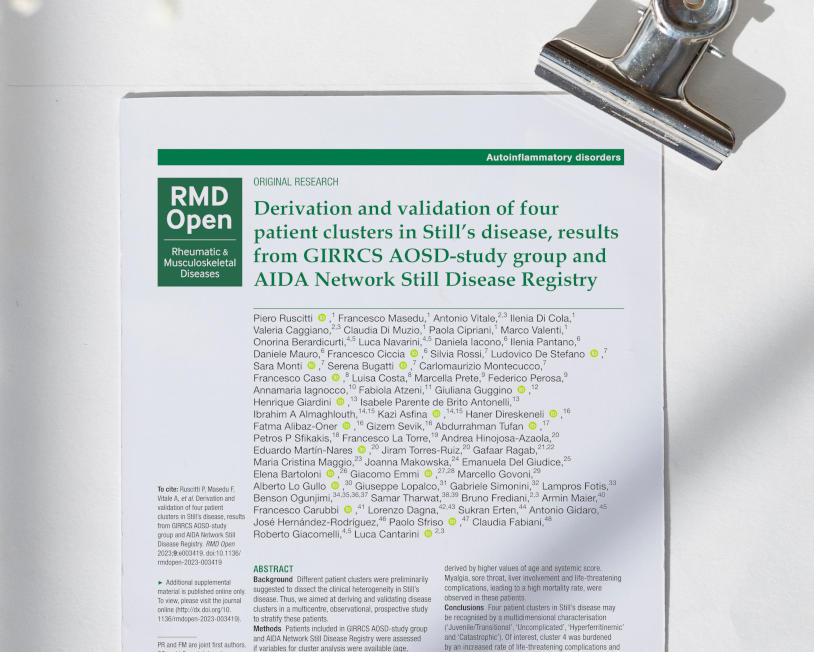
In a groundbreaking multidimensional study, four distinct patient clusters in Still's disease have been identified through the comprehensive analysis of clinical variables. Utilizing the K-means algorithm and evaluating key parameters such as age, systemic score, erythrocyte sedimentation rate, C-reactive protein, and ferritin, this research effort, encompassing 349 patients from the GIRRCS AOSD-study group and the international AIDA Network registry for Still Disease, has redefined our understanding of clinical heterogeneity in this condition.
The identified clusters, namely 'Juvenile/Transitional,' 'Uncomplicated,' 'Hyperferritinemic,' and 'Catastrophic,' provide a nuanced classification that goes beyond the traditional categorizations. Each cluster exhibits distinctive clinical characteristics, shedding light on the diverse manifestations of Still's disease. Notably, Cluster 4 emerged as particularly significant, showcasing an elevated risk of life-threatening complications and higher mortality rates, suggesting a more severe patient subgroup.
This groundbreaking clustering approach revolutionizes the current knowledge surrounding the classification of Still's disease patients. By offering a more refined and personalized stratification based on distinct clinical profiles, this novel insight becomes a valuable tool for tailoring treatment approaches according to individual risk levels. The identification of these clusters marks a pivotal advancement in our ability to navigate the complexities of Still's disease, paving the way for more targeted and effective therapeutic strategies.