Research
New Study from the AIDA Network Registry Identifies Risk Factors for Intestinal Involvement in Behçet’s Disease
International data from the AIDA Network Behçet’s Disease Registry highlight the prognostic role of major aphthosis in patients with mucocutaneous-onset Behçet’s disease.
Link to article
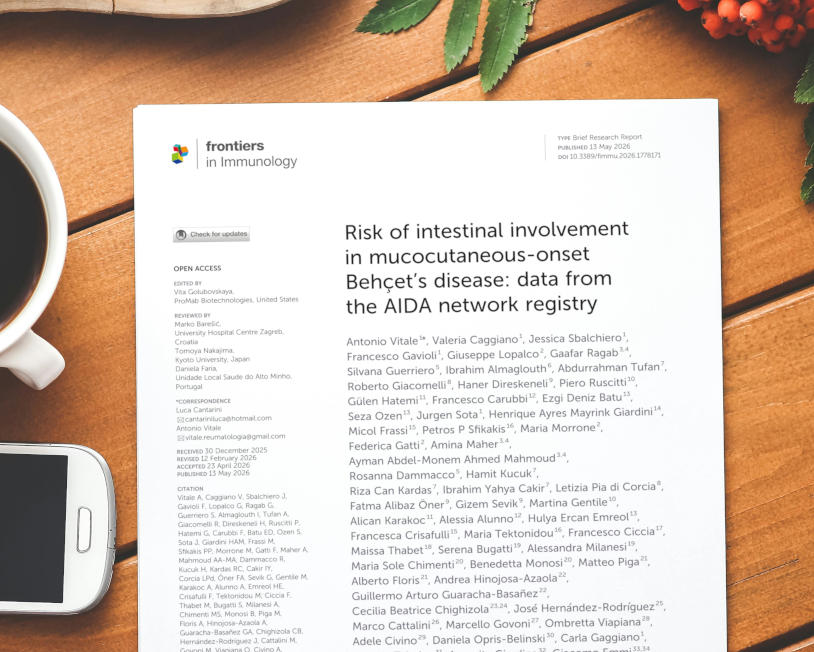
A new study based on data from the AIDA Network Behçet’s disease registry has recently been published in the journal Frontiers in Immunology, providing important insights into the risk of developing intestinal involvement in patients with Behçet’s disease initially presenting with mucocutaneous manifestations only.
The study analyzed data from 328 patients enrolled in the international AIDA Network Behçet’s disease registry who showed an exclusively mucocutaneous onset of disease. Among them, 14% developed intestinal involvement over time.
The analysis demonstrated that major oral aphthosis represented the strongest factor associated with subsequent intestinal involvement. In particular, the risk further increased when major aphthous ulcers were associated with genital aphthosis and pseudofolliculitis. Conversely, patients presenting exclusively with minor oral aphthous ulcers showed a lower probability of developing intestinal manifestations.
Interestingly, the study also showed that patients who developed intestinal involvement had a significantly higher risk of ocular inflammation, underlining the importance of careful multidisciplinary follow-up in this subgroup of patients.
These findings contribute to improving early risk stratification in Behçet’s disease and once again emphasize the value of the AIDA Network registries in advancing international collaborative research on rare and complex inflammatory disorders.