Research
New Publication from the AIDA Network Registry on VEXAS Syndrome: The Role of Recurrent Fever
We are pleased to share a new scientific publication arising from data collected within the International AIDA Network VEXAS syndrome Registry.
Link to article
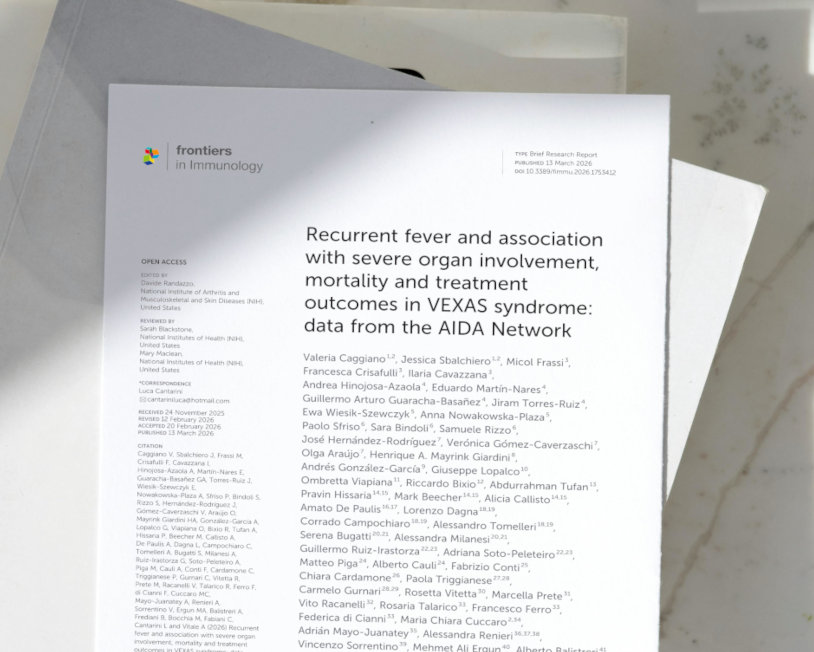
The study, titled “Recurrent fever and association with severe organ involvement, mortality and treatment outcomes in VEXAS syndrome: data from the AIDA Network”, provides important insights into one of the hallmark features of this rare disease: recurrent fever.
VEXAS syndrome is a complex autoinflammatory condition characterized by systemic inflammation and multi-organ involvement. Recurrent fever is one of its most frequent manifestations, often impacting patients’ daily lives and potentially reflecting underlying disease severity.
In this study, 87 patients from the AIDA Network registry were analyzed, with nearly 75% experiencing recurrent febrile episodes. The results highlight that fever is not merely a symptom, but a significant clinical indicator. Indeed, recurrent fever was strongly associated with severe organ involvement, particularly affecting the heart, lungs, and gastrointestinal system. Importantly, it was also linked to a higher risk of mortality.
The study further explored treatment outcomes, showing that patients with recurrent fever more commonly achieved partial responses to therapies such as conventional disease-modifying anti-rheumatic drugs (DMARDs), Janus kinase inhibitors, and tocilizumab. Conversely, very high fever (above 40°C) was associated with a high probability of treatment failure when using anti-interleukin-1 agents.
Overall, these findings suggest that recurrent fever may serve as a valuable clinical marker to guide therapeutic decisions in VEXAS syndrome. Monitoring fever patterns could help clinicians better stratify patients and tailor more effective treatment strategies.
This publication represents an important step forward in improving our understanding of VEXAS syndrome and optimizing patient care through real-world data from the AIDA Network.